
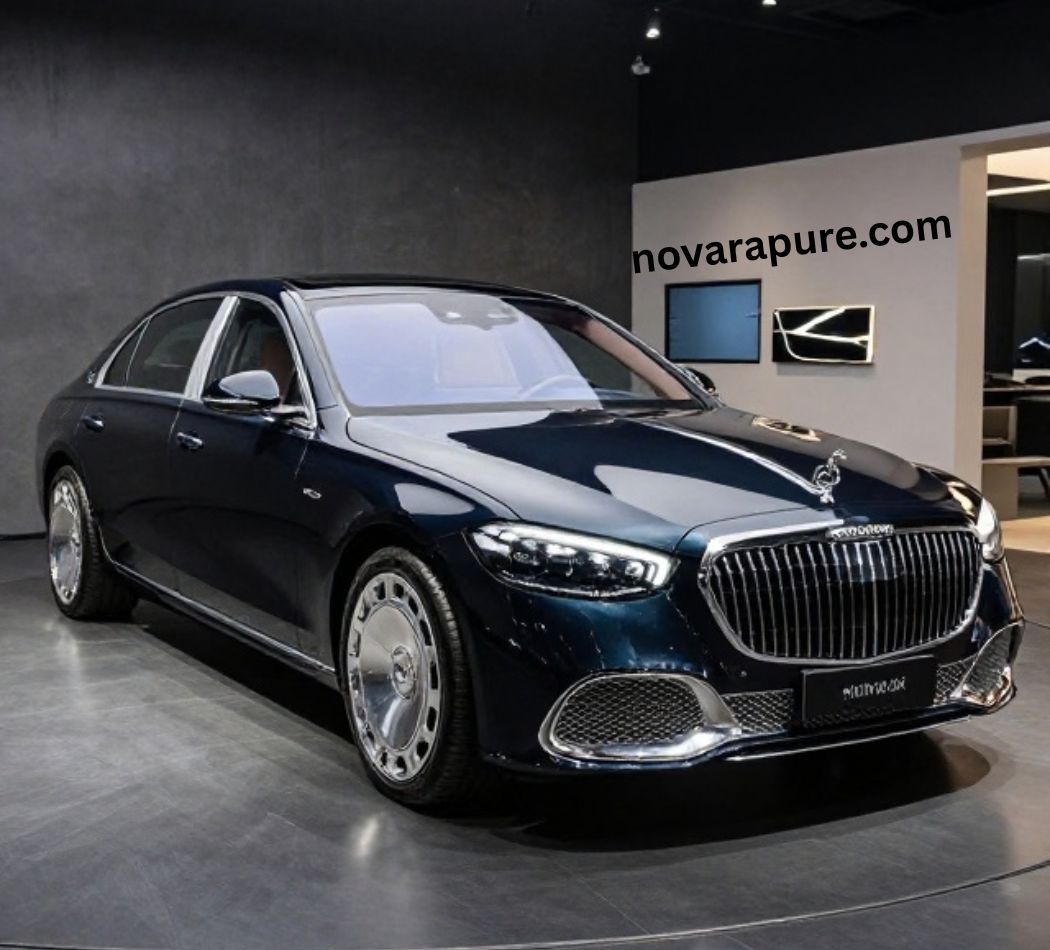
We Tested:
What do you call a car that costs more than most houses, accelerates like a sports car, and cossets its rear passengers like a private jet cabin? Mercedes-Benz calls it the Maybach S680 4MATIC—and in 2026, it remains one of the last true V12 sedans on American roads.
Here’s the surprising part: while nearly every luxury automaker races toward electrification and downsizing, Maybach is doubling down on twelve cylinders. The brand’s boss, Markus Bauer, recently admitted that once a Maybach customer wants a V12, it is “hard to convince them to buy a V8”. That’s not marketing spin—it’s a genuine insight into what ultra-wealthy buyers actually want.
This article dives deep into the Mercedes-Maybach S680: its handcrafted engine, its palace-like interior, how it stacks up against Rolls-Royce, what it costs to own, and why this magnificent dinosaur may be the last of its kind.
Background: From Faded Glory to Cultural Phenomenon
The Maybach Story Isn’t What You Think
Most people assume Maybach has always been a Mercedes sub-brand. Not true.
Wilhelm Maybach founded the company in 1909, and it built some of the most opulent cars of the pre-war era. After World War II, Daimler-Benz bought what remained of Maybach in 1960, and the nameplate essentially disappeared for decades.
Then came 2002. Mercedes revived Maybach as a standalone ultra-luxury brand, launching the 57 and 62 models to challenge Rolls-Royce directly. The cars were engineering marvels—but they flopped commercially. By 2012, Maybach was dead again, having sold just 46 cars in Europe the previous year.
The Resurrection That Actually Worked
The 2014 decision to reposition Maybach as a luxury sub-brand—essentially an ultra-premium trim level for existing Mercedes models—changed everything. Instead of building bespoke platforms nobody bought, Mercedes could leverage the S-Class’s already exceptional foundation and pile on exclusivity.
By 2019, a Car and Driver study found that Maybach had been mentioned in popular songs more than Rolls-Royce and Ford combined over the previous four decades. The brand had become cultural shorthand for wealth—appearing in everything from Succession to rap lyrics.
Today, the Mercedes-Maybach S680 sits at the top of the S-Class hierarchy, a rolling testament to the idea that sometimes “more” really is more.
The Heart of the Beast: The Handcrafted V12
What Makes This Engine So Special?
The S680’s powertrain is its defining feature. Under the hood sits a handcrafted 6.0-liter twin-turbo V12 (engine code M279) producing 621 horsepower and 664 lb-ft of torque in North American specification.
That torque figure arrives at just 2,000 RPM and holds steady until 4,000 RPM—which means the S680 doesn’t so much accelerate as surge forward with the inevitability of a tidal wave. Mercedes quotes a 0-60 mph time of 4.5 seconds, which is remarkable for a vehicle weighing roughly 5,200 pounds.
But here’s what the spec sheet doesn’t tell you: the V12 is silent until you demand otherwise. At cruising speed, you hear almost nothing. It’s only when you bury the throttle that the engine emits a distant, dignified murmur—never a roar, never a shout.
The V12 Is Disappearing—But Not Everywhere
This is where things get interesting for 2026. In Europe, tightening emissions regulations have forced Mercedes to drop the V12 from the Maybach lineup entirely. European S680 models now use a mild-hybrid V8 producing 603 horsepower.
But in North America, China, Japan, South Korea, and the Middle East? The V12 lives on. Markus Bauer told reporters that the United States is the “strongest V12 market” in the world, and Maybach’s ambition is “always to offer the V12” in markets where customers demand it.
In other words: if you’re reading this in America and you want a new V12 Maybach, you’re in luck. But the geographic window is narrowing.
Inside the Palace: Luxury That Borders on Absurd
The Rear Seat Is the Point
The Maybach S680 is not a car you drive. It’s a car you’re driven in.
The standard configuration is a four-seat layout with two individual rear thrones separated by a broad center console. The seats recline to 43 degrees, feature heating, ventilation, and massage functions, and come with plush throw pillows and cushioned headrests. There’s a rear refrigerator, optional champagne flutes (metal, naturally), folding tables, and dual 13.1-inch rear displays with gaming, browsing, and streaming capabilities.
The materials are what you’d expect: Nappa leather in virtually any color you can imagine, open-pore woods, and metal accents that feel cool and substantial to the touch.
The Burmester System Is Genuinely Remarkable
Let’s talk about the audio. The S680 features a Burmester 4D surround sound system with 31 speakers and 1,690 watts of power. Motor1’s reviewer called it “the single most excellent audio experience I’ve ever heard in a car.”
This isn’t just about volume—it’s about spatial precision. The system uses Dolby Atmos and can place individual instruments around the cabin with startling accuracy. For rear passengers, it’s like having a private concert hall that happens to be moving at 70 mph.
The MBUX Superscreen: Tech Without Clutter
Up front, the dashboard is dominated by a glass expanse housing a 12.3-inch digital gauge cluster, a 14.4-inch central touchscreen, and a 12.3-inch passenger display. The latest MBUX system is a significant improvement over previous versions, with faster response times, wireless Apple CarPlay and Android Auto, and an AI-powered voice assistant that actually understands natural language.
But here’s the clever part: the S680 doesn’t feel like a tech showcase. The screens recede when not in use, the physical controls that remain (volume, cruise control, climate) are beautifully weighted, and the ambient lighting can be tuned to 64 colors or set to dynamic themes that respond to driving modes.
How the S680 Compares to the Rolls-Royce Ghost
The Numbers
| Specification | Maybach S680 | Rolls-Royce Ghost |
|---|---|---|
| Starting MSRP (USD) | ~$245,650 | ~$355,000 |
| Engine | 6.0L Twin-Turbo V12 | 6.75L Twin-Turbo V12 |
| Horsepower | 621 hp | 563 hp |
| Torque | 664 lb-ft | 627 lb-ft |
| 0-60 mph | 4.5 sec | 4.6 sec |
| Length | 215.3 in | ~218 in |
| Combined MPG | 15 | 14 |
Sources: KBB, Cars.com, CarExpert
The Real-World Difference
On paper, the Maybach wins on power, torque, acceleration, and price. It’s also more fuel-efficient and comes with a longer warranty (5 years vs. 4).
But the Ghost offers something the Maybach can’t match: bespoke construction. Every Rolls-Royce is built to order, with a level of customization that borders on obsessive. The Maybach is an exceptionally luxurious Mercedes—the Ghost is a Rolls-Royce.
That distinction matters to a certain type of buyer. The Maybach appeals to those who want the best Mercedes makes. The Rolls appeals to those who want the best anything makes.
In practice, the Maybach is the more usable car. Its tech is more modern, its ride is arguably more comfortable at speed, and it doesn’t attract quite the same level of gawking attention. But if you’re spending this much on a car, “usable” may not be your primary concern.
What It Costs to Own: The Unvarnished Truth
Purchase Price and Depreciation
The 2026 Maybach S680 4MATIC starts at approximately **$244,400**, though options can easily push that past $270,000. Special editions like the V12 Edition (limited to 50 units) command significantly more.
Depreciation is brutal. One analysis estimates that over five years, an S680 will retain roughly $157,000 of its original value**, with total ownership costs approaching **$199,300. That’s a depreciation rate of nearly 40%—typical for ultra-luxury sedans, but still sobering.
Maintenance and Running Costs
Routine maintenance isn’t as catastrophic as you might expect. OpenLaborProject data shows **5-year routine maintenance labor costs of approximately $11,976** for the V12 model—about $659 more than the V8 variant.
The V12 actually has some maintenance advantages: spark plugs are easier to access (1.4 hours vs. 2.5 hours for the V8), and the water pump replacement time is nearly half (4.5 hours vs. 8.5 hours). But brake jobs cost more: 2.2 hours per axle versus 1.2 hours for the V8.
Annual fuel costs? At 15 MPG combined and premium fuel, expect $4,000-$5,000 per year for average driving. Insurance for a car in this price bracket typically runs $4,000-$6,000 annually depending on location and driving record.
Special Editions: When “Standard” Isn’t Enough
Mercedes has embraced the limited-edition model for Maybach, and 2025-2026 has seen some remarkable examples.
The V12 Edition
Unveiled at the historic Fort Michelangelo in Civitavecchia, Italy, the Mercedes-Maybach V12 Edition is limited to just 50 units worldwide. It features a two-tone MANUFAKTUR paint finish, 24-karat gold accents, and handcrafted interior details that celebrate the brand’s V12 heritage dating back to the legendary Zeppelin models of the 1920s.
Daniel Lescow, director of Mercedes-Maybach, described it as “a limited edition of just 50 units that displays the brand’s legacy”.
The Northern Lights Edition
For the Japanese market, Mercedes created the S680 Edition Northern Lights, limited to just 5 units. It features a bespoke body color inspired by the aurora borealis and the same 612 PS V12 powertrain.
Edition Emerald Isle
Debuted at Pebble Beach in 2025, this coastal-inspired edition includes Maybach door sills with floral designs, high-pile floor mats with embroidered logos, and the Executive Rear Seat Package Plus with refrigerator and champagne flutes.
These editions aren’t just marketing exercises—they’re a response to customer demand for exclusivity that goes beyond the already-exclusive standard car.
Common Mistakes Buyers Make (And How to Avoid Them)
Mistake #1: Assuming the V8 Is “Enough”
The S580’s 496-horsepower V8 is a magnificent engine. But as Markus Bauer acknowledged, Maybach buyers who want a V12 simply won’t consider a V8. The twelve-cylinder engine isn’t just about performance—it’s about presence. It’s a statement of intent that no V8, however powerful, can replicate.
Solution: If you’re considering a Maybach, drive both. The V12’s character—its silence, its smoothness, its effortless torque delivery—is qualitatively different.
Mistake #2: Ignoring the Rear Seat Configuration
Many buyers default to the standard five-seat layout. But the four-seat Executive Rear Seat Package Plus transforms the car into something closer to a private jet cabin. If you’ll primarily be chauffeured, this is the configuration you want.
Mistake #3: Forgetting About Depreciation
Ultra-luxury sedans depreciate faster than almost any other vehicle category. Buying new means absorbing the steepest part of that curve.
Solution: Consider a lightly used certified pre-owned model. A two-year-old S680 with low mileage can save you $50,000 or more while still offering the full Maybach experience.
Mistake #4: Underestimating Running Costs
The purchase price is just the beginning. Fuel, insurance, maintenance, and tires (those 20-inch run-flats aren’t cheap) add up quickly.
Solution: Budget at least $15,000-$20,000 annually for ownership costs beyond the purchase price.
Pros, Cons, and Balanced Analysis
The Case For
The V12 is irreplaceable. There is no substitute for twelve cylinders firing in perfect harmony. The S680’s engine is a masterpiece of engineering—smooth, silent, and effortlessly powerful.
Rear-seat comfort is class-leading. The four-seat configuration with massaging, reclining thrones is arguably the most comfortable rear cabin in any sedan, at any price.
Tech is genuinely useful. The MBUX system, Burmester audio, and driver assistance features are best-in-class and actually enhance the ownership experience.
It’s more usable than a Rolls. The Maybach is slightly smaller, more fuel-efficient, and less conspicuous than a Ghost. For daily driving, that matters.
The Case Against
Depreciation is punishing. You’ll lose six figures in value over five years. There’s no way around it.
It’s still a Mercedes. Purists will note that the S680 shares its platform, switchgear, and basic architecture with the standard S-Class. At this price point, some buyers want something truly bespoke.
The V12’s future is uncertain. Regulations are tightening. The S680’s V12 may not survive the next decade in all markets. That’s a risk if you’re buying for the long term.
Fuel economy is woeful. 15 MPG combined is the price of admission. If that bothers you, this isn’t the car for you.
The Future: What Happens to the S680 Next?
The V12’s Days Are Numbered (Probably)
Mercedes has committed to an all-electric future, but the timeline keeps shifting. The V12 remains available in key markets for now, but European regulations have already killed it there. The question isn’t if the V12 disappears from the Maybach lineup, but when.
Markus Bauer’s comments suggest Mercedes will keep the V12 as long as customers demand it—and in America, they clearly do. But regulatory pressure is inexorable.
Electrification Is Coming
Maybach already offers the S580e, a plug-in hybrid with a turbocharged inline-six. A fully electric Maybach is almost certainly in development, though Mercedes hasn’t confirmed a timeline.
The challenge is that electric powertrains don’t naturally deliver the same emotional experience as a V12. The silence is there, but the character isn’t. Maybach engineers will need to figure out how to make an EV feel as special as a twelve-cylinder sedan. That’s no small task.
The Collector Car Angle
Here’s a contrarian take: the S680 V12 may become a collector’s item precisely because it’s an endangered species. We’ve seen this pattern before—the Porsche 911’s air-cooled engines, the BMW M5’s naturally aspirated V10, the Lexus LFA’s V10. When an iconic engine goes away, demand for the last examples often increases.
If you’re buying an S680, consider it not just as a luxury purchase but as a potential long-term hold. The V12 Edition, limited to 50 units, is the most obvious candidate for appreciation.
Key Takeaways: What You Need to Remember
-
The Maybach S680 is the ultimate expression of the V12 luxury sedan—621 horsepower, 664 lb-ft, and a 0-60 time of 4.5 seconds.
-
Rear-seat comfort is the headline feature, with massaging, reclining thrones and a Burmester audio system that’s genuinely extraordinary.
-
The V12 is disappearing in Europe but remains available in North America, China, Japan, South Korea, and the Middle East—at least for now.
-
**It costs roughly $245,000 to start**, with total five-year ownership costs approaching $200,000 including depreciation.
-
It competes with the Rolls-Royce Ghost but is more usable, more tech-forward, and significantly cheaper—though less bespoke.
-
Special editions like the V12 Edition (50 units) offer even greater exclusivity and potential collector value.
-
If you want a V12 Maybach, buy sooner rather than later. The window is closing.
Frequently Asked Questions
Q: Is the Mercedes-Maybach S680 the same as a regular S-Class?
A: No. While it’s based on the S-Class platform, the Maybach S680 features a unique V12 engine (not available in the standard S-Class), a longer wheelbase, exclusive interior materials, and a distinct exterior design with more chrome and the iconic Maybach grille.
Q: How much does a 2026 Maybach S680 cost?
A: The base MSRP is approximately **$244,400**, though options and special editions can push the price well past $270,000.
Q: Does the Maybach S680 still have a V12 in 2026?
A: Yes, in North America, China, Japan, South Korea, and the Middle East. In Europe, the V12 has been replaced by a mild-hybrid V8 due to emissions regulations.
Q: How fast is the Maybach S680?
A: Mercedes quotes 0-60 mph in 4.5 seconds and a top speed limited to 130 mph.
Q: Is the Maybach S680 reliable?
A: The V12 engine has a long track record of reliability in Mercedes applications. Routine maintenance is required, but major failures are rare. The most significant ownership cost is depreciation, not repairs.
Q: What’s the difference between the S580 and S680?
A: The S580 has a 496-hp 4.0-liter twin-turbo V8. The S680 has a 621-hp 6.0-liter twin-turbo V12. The S680 also comes with additional standard features and is significantly more expensive.
Q: Can you still order a Maybach S680 with the V12 in the US?
A: Yes. The V12 remains available in the US market, and Maybach has confirmed its commitment to offering it as long as customer demand persists.
Q: How many Maybach S680s are produced each year?
A: Mercedes doesn’t publicly break down production figures by model, but inventory data suggests the S680 is produced in limited numbers. One report noted just 34 examples in US inventory at a given time in 2026.
Sources
-
Cars.com — 2026 Mercedes-Benz Maybach S 680 Trim Levels & Configurations
-
KBB — 2026 Mercedes-Benz Mercedes-Maybach S-Class Specs
-
Mercedes-Benz Canada — 2026 Mercedes-Maybach S 680 4MATIC Sedan Specifications
-
Motor1 — “The V12 Mercedes-Maybach S680 Makes You Feel Like A Villain: Driven”
-
CarExpert Australia — Mercedes-Maybach S vs Rolls-Royce Ghost Comparison
-
Carscoops — “Maybach Boss Admits American V12 Buyers Won’t Even Consider A V8”
-
OpenLaborProject — Maybach S-Class Maintenance Cost Comparison
-
Mercedes-Benz Media — Mercedes-Maybach V12 Edition Press Release
-
Robb Report — “How Mercedes-Maybach Came Back From the Dead”
-
CarCostBreakdown — Mercedes-Benz S 680 Maybach Ownership Costs

Novara Lin
Senior Editor & Clean Beauty Analyst
Novara Lin is a clean beauty researcher and wellness editor dedicated to demystifying modern skincare and evidence-based living. With a background in formulation science and consumer health reporting, she specializes in analyzing complex ingredient profiles, evaluating product safety, and bridging the gap between clinical research and daily self-care routines. Her work focuses on helping readers cut through industry noise to build minimal, highly effective routines rooted in transparency and skin health. When she isn’t testing active formulations or auditing non-toxic household choices, Novara leads editorial strategy for NovaRa Pure.