
We Tested:
It’s 7:14 a.m. You haven’t finished your coffee. You haven’t checked your email. But you have already typed a five-letter word into a grid of gray squares, stared at two yellow tiles, and felt a tiny, irrational flash of triumph—or defeat.
If you played yesterday’s Wordle, you were one of millions participating in a ritual that has quietly rewired our mornings. And if you’re here now, you probably want to know: What was it? Why was it tricky? And what does it say about how I play?
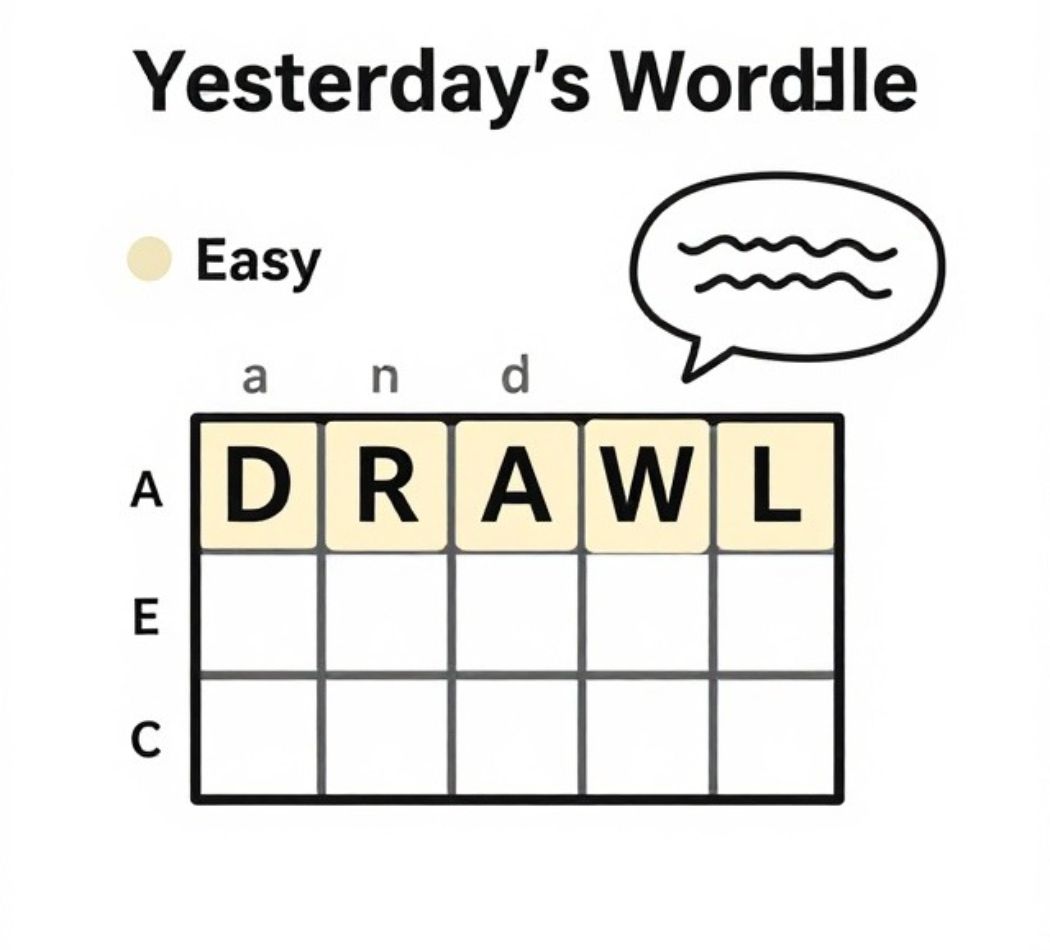
Yesterday’s answer was DRAWL (Wordle #1,976, November 16, 2026). On the surface, it was a straightforward puzzle—the Times’ testers solved it in an average of 3.3 guesses, classifying it as “easy breezy”. Yet DRAWL carries a hidden complexity that exposes the fault lines in every Wordle player’s strategy. It’s a word with one vowel and four consonants. It sounds like something a cowboy says in a slow Western. And it is precisely the kind of answer that separates the planners from the vibes-based guessers.
This isn’t just a recap. It’s a forensic look at what yesterday’s puzzle reveals about strategy, psychology, and the strange economics of a game that makes zero dollars but anchors a media empire.
Background: How a Pandemic Side Project Became a Global Ritual
From 90 Players to Three Million
Wordle wasn’t designed to be a phenomenon. Software engineer Josh Wardle built it in October 2021 as a gift for his partner, who loved word games. It started with roughly 90 daily players. Within months, that number exploded to over three million.
The mechanic was elegantly simple: guess a five-letter word in six tries. Gray means the letter isn’t in the word. Yellow means it’s there but misplaced. Green means it’s locked in. No app, no signup, no ads. Just one word per day, shared by everyone on the planet.
What supercharged the growth wasn’t the puzzle itself—it was the share button. The spoiler-free emoji grid let players broadcast their results without ruining the answer, turning every solved puzzle into a tiny social flex. By January 2022, the New York Times acquired Wordle for a reported “low seven figures,” keeping it free.
The 2026 Landscape: A Changed Game
By late 2026, Wordle looks slightly different. In February, the Times announced a quiet but significant rule change: previously used words could now return as solutions. For years, the game had drawn from a finite pool of answers, never repeating. That constraint is gone. The change doesn’t affect casual players, but for the strategists—the ones who retired a starting word after it appeared as a solution—it reshuffled the calculus.
Yesterday’s DRAWL, therefore, exists in a Wordle ecosystem where the old certainties are eroding. And that makes every guess a little more interesting.
The Anatomy of DRAWL: Why One Vowel Broke (Some) Brains
The Letter Distribution Problem
DRAWL is a consonant-heavy word. One vowel. Four consonants. The vowel is A, and it sits in the second position. The consonants—D, R, W, L—include one of the rarest letters in English (W) and one of the most common (R).
If your starting word was ADIEU—the popular four-vowel opener—you learned almost nothing useful from DRAWL. You’d have seen the A turn yellow or green, but the remaining four letters were untouched territory. The vowel-heavy strategy, which prioritizes eliminating vowels, fails spectacularly when the answer contains only one.
If your starter was SLATE, CRANE, or RAISE—the computer-approved favorites—you were in much better shape. Those words contain A and R (or L), giving you immediate footholds. A player who opened with CRANE, for example, would have seen the R turn yellow and the A turn yellow, narrowing the field considerably.
The “Easy” Label Was Misleading
The Times’ difficulty rating is based on average guesses across its tester pool, not on the word’s intrinsic trickiness. DRAWL scored 3.3—technically easy. But averages hide outliers. For players anchored to vowel-heavy openers or those who burned guesses on words like MOIST and POUTY, DRAWL likely stretched into guess five or six.
The word’s semantic quality matters too. DRAWL is evocative but not common. It’s the kind of word you recognize instantly but rarely use in conversation. That recognition gap creates a curious cognitive lag: your brain knows it’s a word, but your fingers hesitate.
The Strategy Wars: What DRAWL Taught Us About Starting Words
The Case Against ADIEU (Revisited)
The ADIEU debate has raged for years. The logic seems sound: four vowels in one guess eliminates most of the vowel uncertainty. But as Lifehacker noted in early 2026, vowels don’t narrow down possibilities efficiently. Knowing that A is in the word tells you very little—A appears in thousands of five-letter words. Knowing that R and L are present, and roughly where they sit, is far more constraining.
DRAWL is the perfect case study. A player who opened with ADIEU learned: A is present. That’s it. A player who opened with SLATE learned: A is present, L is present, and the positions of both are wrong. That’s actionable intelligence.
The Consonant-First Framework
The 2026 consensus among data-driven players leans toward consonant-rich openers. The New York Times’ own 2023 analysis ranked SLATE as the most effective of the 30 most popular starters, followed by CRANE, LEAST, STARE, and RAISE. ADIEU ranked thirtieth.
But here’s the nuance most articles miss: the “best” starting word depends on what you want from it. If you want a chance at a one-guess miracle, you need a word that could actually be a solution. Computer-optimal words like SALET (a medieval helmet) and TARSE are statistically excellent but will almost certainly never appear as an answer. If you’re playing for the streak—the daily ritual, the share grid, the group chat banter—then a word like CRANE or SLATE offers the best balance of information and plausibility.
Yesterday’s Lesson, Generalized
DRAWL rewarded players who had already eliminated D, R, W, and L. If you opened with WORDY (a cheeky but inefficient choice), you’d have seen D and R light up—a lucky break. If you opened with CLOUD, you’d have caught the D and L. The lesson isn’t that any one word is magic. It’s that coverage of high-frequency consonants matters more than vowel hoarding.
Beyond the Grid: The Psychology and Social Life of Wordle
The “Drip” of Connection
Why do we care about a five-letter word? Dr. Michelle Drouin, a psychology professor at Purdue University Fort Wayne, offered a framework in a 2026 interview: Wordle provides a “drip” of social connection when we can’t give a “drench”.
The daily group chat messages—“Got it in three” / “Struggled with this one” / “What even is a DRAWL?”—are low-stakes social glue. They require no scheduling, no emotional labor, no lengthy replies. They say: I’m here. I’m thinking of you. We’re doing this together.
For families separated by distance, for friend groups scattered across time zones, for colleagues who barely speak otherwise, the Wordle grid has become a tiny shared ritual. It’s connection by algorithm, and it works.
The Luck Illusion
Here’s an uncomfortable truth that Wordle players rarely admit: solving in fewer guesses is largely luck. Your first guess interacts with the day’s answer in ways you cannot control. If you open with CRANE and the answer is DRAWL, you’re in a decent position. If you open with MOIST and the answer is DRAWL, you’re scrambling.
The skill lies in information management—how efficiently you convert each guess into constraints. But the initial hand you’re dealt is random. This is why the “average guesses” metric is so misleading as a measure of intelligence or skill. A three-guess solve on an easy word and a five-guess solve on a hard word might reflect the same quality of play.
Practical Tips: How to Play Smarter (Without Becoming Insufferable)
1. Ditch the Vowel Obsession
ADIEU is not your friend. A balanced opener with common consonants—CRANE, SLATE, TRACE, STARE—gives you more actionable constraints. If you’re attached to a vowel-heavy start, at least pair it with a consonant-rich second guess.
2. Treat Guess Two as a Constraint Engine
Your second guess should eliminate the most possibilities, not chase a hunch. If your opener revealed an A in position three and a yellow R, don’t guess a word that feels right. Guess a word that tests the most plausible remaining structures. Words like POINT or MOLDY can be surprisingly informative.
3. Embrace the Yellow
A yellow letter is often more valuable than a green one. Green locks a position but tells you nothing about other instances of that letter. Yellow tells you the letter exists and that it’s not where you put it—two pieces of information in one tile.
4. Don’t Fear the Obscure (But Don’t Chase It)
Words like DRAWL remind us that Wordle’s answer pool includes rich, textured vocabulary. If you’re stuck with_ R A _ _ and you’ve eliminated the obvious options, consider words that are slightly literary or regional. BRAWL, CRAWL, DRAWL—the -AWL family is real and occasionally deadly.
Common Mistakes (And How to Fix Them)
| Mistake | Why It Hurts | The Fix |
|---|---|---|
| Using the same starter forever without analyzing results | You stop learning from your own data | Track your starters. If one consistently leaves you with weak constraints, switch. |
| Guessing “feeling” words instead of constraint-testing words | You waste a guess on a hunch that doesn’t eliminate possibilities | Ask: What will this guess teach me if it’s wrong? |
| Ignoring repeated letters | Wordle answers do contain doubles (e.g., FLUFF, EERIE) | If you’re stuck, test a double. It’s cheaper than losing. |
| Rage-quitting after a bad start | The streak is the ritual; the score is secondary | Remember: even the Times’ testers average over three guesses. You’re fine. |
Pros, Cons, and the Wordle Paradox
Pros of the current Wordle era:
-
The repeat rule change (February 2026) keeps the answer pool unpredictable and fair.
-
The game remains free, ad-free, and accessible.
-
The social sharing mechanic continues to foster genuine connection.
Cons and tensions:
-
The “easy/hard” labels can mislead, creating unnecessary frustration.
-
The strategy discourse has become noisy—everyone has a “perfect” starter, and most of them are mediocre.
-
The game’s simplicity means it cannot evolve much without breaking what makes it work.
The paradox: Wordle generates no direct revenue. It has no ads, no paywall, no in-game purchases. Yet it anchors a subscription ecosystem that helped push the New York Times to 13.4 million total subscribers by mid-2026, with digital subscription revenue rising 16.4% to $408 million in a single quarter. Wordle is the front door. The subscription bundle is the house. And the daily habit is the key that keeps people walking through.
Future Trends: What’s Next for Wordle in 2027 and Beyond
1. The repeat era matures. As previously used words re-enter circulation, the community will develop new heuristics for tracking and predicting repeats. Third-party tools will proliferate, though the Times will likely keep official hints vague.
2. Monetization experiments will continue. The Times has already introduced paid Wordle variants (archives, extra puzzles) without touching the core free game. Expect more premium tiers that deepen engagement without gating the daily ritual.
3. AI will change how people cheat—and how they learn. Solvers already use LLMs to generate guesses. The next frontier is constraint-aware AI that explains why a guess is good, not just what to guess. Whether that enhances or erodes the joy of the puzzle is an open question.
4. The social ritual will outlast the game. Even if Wordle’s player base plateaus, the group chats will persist. The habit is stickier than the puzzle. The “drip” of connection doesn’t require novelty; it requires consistency.
Conclusion: What Yesterday’s Wordle Really Taught Us
Yesterday’s Wordle was DRAWL. It was, by the numbers, an easy puzzle. But it exposed the difference between playing to win and playing to understand—between chasing vowels and building constraints, between guessing and thinking.
More than that, it reminded us why we play at all. Wordle is not a test of intelligence. It is a daily excuse to say hello. It is a five-letter word that means “to speak slowly,” delivered to a world that rarely slows down.
Key Takeaways:
-
Yesterday’s Wordle (#1,976) was DRAWL—a one-vowel, four-consonant word that punished vowel-hoarding openers.
-
Consonant-rich starters like CRANE, SLATE, and RAISE consistently outperform vowel-heavy options like ADIEU.
-
The February 2026 rule change allowing repeated solutions has made the game less predictable and more interesting.
-
Wordle’s real value isn’t the puzzle—it’s the daily social ritual it enables.
-
The game generates no revenue but drives subscription retention for the New York Times, which reached 13.4 million subscribers in 2026.
Detailed FAQs
What was yesterday’s Wordle answer?
Yesterday’s Wordle (#1,976, November 16, 2026) was DRAWL.
Was yesterday’s Wordle considered hard?
No. The Times’ testers averaged 3.3 guesses, labeling it “easy breezy”. However, players who opened with vowel-heavy words may have found it trickier than the rating suggests.
What is the best Wordle starting word in 2026?
There’s no single “best” word, but computer analyses consistently rank SLATE, CRANE, and RAISE among the most effective. The key is balancing common consonants with a vowel that actually narrows possibilities.
Did Wordle change its rules in 2026?
Yes. As of February 1, 2026, the New York Times began allowing previously used words to return as solutions. Before this, Wordle had never repeated an answer.
Why does Wordle matter if it makes no money?
Wordle functions as a retention engine. It builds a daily habit that keeps users inside the New York Times ecosystem, feeding a subscription bundle that generated over $400 million in digital revenue in a single quarter of 2026.
What should I do if I’m stuck on a Wordle?
Stop guessing words that “feel right.” Instead, guess a word that tests the most common remaining letter combinations. If you have _ R A _ _, try BRAWL or CRAWL to test the -AWL pattern before committing to a final answer.
Sources
-
The New York Times, “Wordle Review No. 1,976” (November 16, 2026)
-
The New York Times, “Wordle Review No. 1,977” (November 17, 2026)
-
ABC News (Australia), “Codecracking, community and competition: Why the word puzzle Wordle has become a new online obsession” (January 2022)
-
Lifehacker Australia, “Why ‘ADIEU’ Is a Terrible Wordle Starter, and What You Should Use Instead” (February 2026)
-
AInvest, “Wordle Makes No Money, Yet It Anchors an $11 Billion Business” (October 2026)
-
Yahoo/Parade, “Get Today’s Wordle #1976 Answer and Hints” (November 2026)
-
Mashable, “Wordle today: The answer and hints for November 16, 2026”
-
IGN India, “Wordle Today (#1976): Hints and the Answer” (November 2026)
-
Yahoo/Milwaukee Journal Sentinel, “Why my most meaningful group chat is about Wordle” (September 2026)
-
BBC Newsround, “What is Wordle?” (January 2022)
-
AInvest, “Wordle Is Free. NYT Still Gets Paid.” (November 2026)

Novara Lin
Senior Editor & Clean Beauty Analyst
Novara Lin is a clean beauty researcher and wellness editor dedicated to demystifying modern skincare and evidence-based living. With a background in formulation science and consumer health reporting, she specializes in analyzing complex ingredient profiles, evaluating product safety, and bridging the gap between clinical research and daily self-care routines. Her work focuses on helping readers cut through industry noise to build minimal, highly effective routines rooted in transparency and skin health. When she isn’t testing active formulations or auditing non-toxic household choices, Novara leads editorial strategy for NovaRa Pure.