
We Tested:
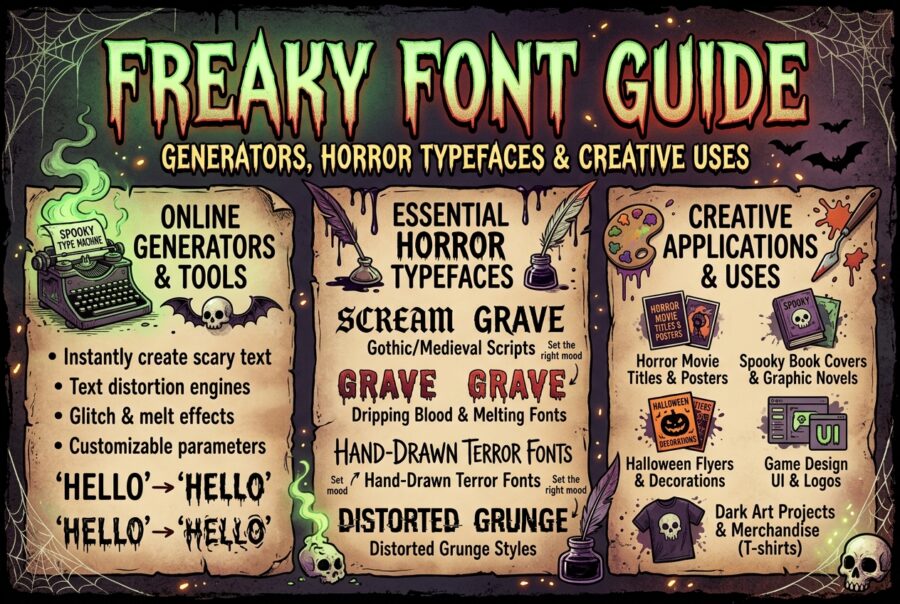
A freaky font is any text style designed to look weird, cursed, glitchy, gothic, or unsettling — from copy-and-paste. Unicode generators to actual horror display typefaces used in posters and logos.
People search for freaky fonts when they want attention-grabbing text for bios, memes, Halloween graphics, game titles, album art, or horror branding.
Key Takeaways:
- “Freaky font” covers generators, Zalgo text, and real horror typefaces
- Copy-paste tools are not the same as installable fonts
- Short headlines work; long paragraphs usually fail
- Always test platform rendering
- Pair weird display type with clean supporting text
- License real fonts properly for commercial work
- Prioritize legibility for any critical information
The important distinction most beginners miss: many “freaky fonts” online are not installable font files. They are stylized Unicode characters you copy and paste. Others are real typefaces with OpenType features for professional design. Knowing which is which saves time and prevents broken text on apps that strip special characters.
This guide explains both worlds, how freaky fonts work, when to use them, and how to keep designs readable instead of chaotic.
Background: Why Freaky Fonts Took Over the Internet?
Freaky text culture grew from several overlapping trends:
- Early forum and chat experiments with unusual Unicode
- Creepypasta and “cursed text” aesthetics (including Zalgo-style stacking)
- Social platforms where bios and usernames need instant personality
- Seasonal demand for Halloween and horror visuals
- Glitch art and cyber-horror design languages
The result is a broad category that includes:
- Copy-paste freaky text generators
- Glitch/Zalgo-style combining-mark text
- True horror and gothic display fonts
- Distorted modern type used in music, gaming, and streetwear
All of them aim for the same emotional hit: this text does not feel ordinary.
What Counts as a Freaky Font?
Use this practical breakdown:
1) Unicode style text
Letters are replaced with mathematical, gothic-looking, or decorative Unicode equivalents. Example: fancy/fraktur-like characters that still paste as text.
2) Zalgo / cursed text
Normal letters plus stacked combining marks above and below, creating a corrupted vertical glitch look.
3) Installed display typefaces
Real fonts with names, licenses, and files (OTF/TTF) used in Canva, Illustrator, Photoshop, Figma, or Word.
4) Effect-based “fonts”
Text treated with glitch, melt, blood-drip, or distortion effects in design software — not always a standalone type family.
If your goal is Instagram bio styling, Unicode generators are usually enough. If your goal is a poster or logo, use a real typeface.
How Freaky Font Generators Work?
Most free “freaky font generator” tools do one or both of these:
- Character mapping: swap A for a lookalike Unicode glyph
- Mark stacking: attach combining diacritics to create distortion
That is why generated text:
- Can be copied quickly
- Often works in captions and bios
- May break in some banking apps, older systems, or strict forms
- Can change character counts because one visual letter may equal multiple code points
This is also why accessibility and search indexing can suffer when entire paragraphs are converted into decorative Unicode.
Popular Freaky Styles and When to Use Them?
| Style | Look | Best use | Risk |
|---|---|---|---|
| Gothic / blackletter | Old manuscript horror | Titles, Halloween headers | Poor long-paragraph readability |
| Fraktur-like Unicode | Dense ornate letters | Short social names | Platform rendering differences |
| Zalgo / cursed | Vertical glitch corruption | Memes, horror captions | Quickly becomes unreadable |
| Glitch display fonts | Digital breakdown | Music, gaming, cyber-horror | Needs strong hierarchy |
| Blood/drip fonts | Gore theatricality | Seasonal posters | Can look cliché if overused |
| Slimy/organic distortion | Wet, unstable edges | Creature-feature branding | Hard at small sizes |
| Upside-down / flipped text | Disorientation | Novelty posts | Weak for serious branding |
| Wavy/weird body Unicode | Playful strangeness | Bios, stickers | Inconsistent across devices |
Real Horror Fonts vs Generator Text
Choose a generator when you need:
- Fast social media styling
- No software installation
- Temporary novelty text
Choose a real freaky/horror font when you need:
- Brand consistency
- Print quality
- Controlled spacing and weights
- Professional poster/logo work
- Licensing clarity
Designers often combine both: a legitimate display font for the official title, and light Unicode styling for social experiments.
Practical Tips for Using Freaky Fonts Well
- Keep freaky text short — one to five words hits harder than a full paragraph.
- Pair weird display type with a clean sans serif for supporting text.
- Test on mobile and desktop before publishing.
- Check contrast; distorted letterforms need stronger color separation.
- Avoid pure Zalgo for essential information like dates, prices, or addresses.
- License commercial fonts properly for client work and merchandise.
- Create an image version (PNG/SVG) when Unicode rendering is unreliable.
- Use freakiness with purpose — horror, humor, rebellion, or surreal branding — not as random decoration.
Step-by-Step: Create Freaky Text for Social Posts
- Write the plain phrase first.
- Decide the emotion: creepy, chaotic, gothic, or playful-weird.
- Run a generator and pick 2–3 readable candidates.
- Paste into the target app and preview.
- If marks collapse or spacing breaks, choose a simpler style.
- Add plain-text context in the same post when needed for clarity.
For design tools:
- Install a horror/display font legally.
- Set the headline in that font.
- Keep body copy normal.
- Adjust tracking and size until the word remains legible at thumbnail scale.
Common Mistakes and Fixes
- Mistake: Converting an entire caption into cursed text
Fix: Limit distortion to the hook line. - Mistake: Using illegible type in logos
Fix: Prioritize recognition; save extreme effects for campaigns, not core marks. - Mistake: Ignoring platform filters
Fix: Always test in Instagram, Discord, TikTok, and your website CMS. - Mistake: Mixing five competing freaky styles
Fix: One dominant weird typeface per layout. - Mistake: Forgetting accessibility
Fix: Provide a plain readable alternative for important messages. - Mistake: Assuming all free font sites are safe/legal
Fix: Prefer reputable foundries and clear license pages. - Pros, Cons, and Balanced Analysis
Pros
- Instant personality and niche aesthetic
- High stop-the-scroll potential
- Useful for seasonal and genre branding
- Generators make experimentation easy
- Real horror fonts can elevate poster-quality design
Cons
- Readability drops fast
- Unicode support is inconsistent
- Overuse looks amateur
- SEO/accessibility penalties for body copy
- Licensing confusion on free download sites
Balanced verdict
Freaky fonts are excellent for emphasis and atmosphere. They are poor replacements for clear communication systems.
Future Trends in Freaky Typography
Expect growth in:
- Variable glitch fonts with controllable distortion axes
- AI-assisted “cursed but readable” text styling
- Horror type released in full variable families, not only one weight
- Better platform support warnings in generators
- More niche micro-genres (folk horror, analog VHS horror, cosmic dread type)
The winning approach will likely be controlled weirdness: expressive, but still intentional.
Tools and Type Directions Compared
| Option | Type | Best for | Learning curve | Output reliability |
|---|---|---|---|---|
| Unicode freaky generators | Copy-paste text | Bios, usernames, memes | Very low | Medium |
| Zalgo generators | Combining-mark text | Cursed meme style | Very low | Low–medium |
| Google Fonts display faces | Installable fonts | Clean-but-odd web use | Low | High |
| Specialty horror foundries | Installable fonts | Posters, packaging | Medium | High |
| Creative marketplaces | Paid display fonts | Client projects | Medium | High |
| Canva font libraries | Managed fonts | Fast social graphics | Low | High |
| Photoshop/Illustrator effects | Distortion workflows | Custom one-offs | Medium–high | High as images |
| Figma + font installs | UI/brand exploration | Digital product moodboards | Medium | High |
| SVG text-as-art exports | Vector graphics | Merch and print | Medium | Very high |
| Hand-drawn lettering | Custom artwork | Unique brand IP | High | Very high |
Who Should Use Which Freaky Font Approach?
| User need | Recommended approach | Why |
|---|---|---|
| Discord nickname flair | Light Unicode style | Fast and reversible |
| Halloween Instagram post | Generator + strong emoji/context | Seasonal punch |
| Horror short-film title | Licensed display font | Cinematic control |
| Metal/band flyer | Blackletter or drip font + clean details | Genre signaling |
| Game UI warning text | Subtle glitch + high legibility | Mood without confusion |
| Student poster project | Free-for-commercial-clear fonts | License safety |
| Brand logo | Custom or carefully chosen display type | Longevity and clarity |
| Meme page growth | Short cursed hooks | Attention economics |
FAQs
What is a freaky font?
A visual text style meant to look weird, scary, glitchy, gothic, or otherwise unconventional.
Are freaky font generators real fonts?
Usually no. Many produce Unicode lookalike characters for copy-and-paste use.
What is Zalgo text?
Text with stacked combining marks that create a corrupted, creeping, glitch-like appearance.
Can I use freaky fonts on Instagram?
Often yes for captions and bios, but results vary by character set and app updates.
Are freaky fonts good for websites?
For headlines maybe; for body text, usually no. Readability and accessibility matter.
What’s better for a horror poster: generator text or a font file?
A real display typeface (or custom lettering) is better for print and professional design.
Do freaky fonts affect SEO?
Decorative Unicode in main content can hurt clarity and indexing. Keep important copy plain.
Is it safe to download free horror fonts?
Use trusted sources and read licenses. Avoid suspicious bundles and always scan files.
Conclusion
Freaky fonts thrive because people want text with attitude. Whether you are generating cursed Unicode for a bio or choosing a full horror typeface for a campaign, the principle is the same: use distortion deliberately, protect readability, and match the style to the job.
Used well, freaky typography creates mood in a second. Used carelessly, it creates noise.
Quick Summary
Freaky fonts are unconventional text styles used for spooky, glitchy, or weird aesthetics. Use Unicode generators for quick social flair and legitimate horror display fonts for professional design, while keeping important information readable.
Short Content Disclaimer
Font availability, platform rendering, and license terms change. Verify commercial-use rights before publishing client or merchandise work. Decorative Unicode may not display consistently across all devices and applications.
Authority sources:
This guide synthesizes common practices around Unicode style generators, Zalgo/combining-mark text, and horror/glitch display typography as used in social and professional design workflows. For commercial projects, rely on official foundry license pages and platform rendering tests.
Source: Stylishfont

Novara Lin
Senior Editor & Clean Beauty Analyst
Novara Lin is a clean beauty researcher and wellness editor dedicated to demystifying modern skincare and evidence-based living. With a background in formulation science and consumer health reporting, she specializes in analyzing complex ingredient profiles, evaluating product safety, and bridging the gap between clinical research and daily self-care routines. Her work focuses on helping readers cut through industry noise to build minimal, highly effective routines rooted in transparency and skin health. When she isn’t testing active formulations or auditing non-toxic household choices, Novara leads editorial strategy for NovaRa Pure.