
We Tested:
Walk into any kayak shop or scroll through a Facebook fishing group for five minutes, and you’ll see the same question framed a dozen different ways: What’s the best fishing kayak?
The honest answer—the one you’ll hear from anyone who has spent real time on the water—is that there is no single best fishing kayak. There is only the right kayak for how you fish, where you fish, and what you can realistically store, transport, and afford. A tournament bass angler chasing largemouth on a sprawling reservoir needs a fundamentally different machine than a weekend angler sneaking into a neighborhood pond with a backpack and two rods.
That’s not a cop-out. It’s the most useful insight in this entire guide. The fishing kayak market has exploded into a $3.8 billion industry projected to keep growing at 6.6% annually, and the range of hull designs, propulsion systems, and price points has never been wider. The risk isn’t that you’ll buy a “bad” kayak. It’s that you’ll buy the wrong kayak—one that sits in your garage because it’s too heavy to car-top, too unstable to stand in, or too slow to reach the fish you actually want to catch.
This guide cuts through the noise. We’ll break down the best fishing kayaks of 2026 by category, explain the trade-offs that actually matter, flag the mistakes that cost anglers hundreds of dollars, and give you a clear framework for choosing a boat you’ll still be happy with three seasons from now.
The 2026 Fishing Kayak Landscape: What Changed and Why It Matters
Five years ago, the kayak fishing conversation was simpler: paddle or pedal. In 2026, that binary is obsolete. The industry has splintered into a spectrum of propulsion options—paddle, fin drive, propeller drive, pedal-assist motors, electric outboards, and even jet propulsion—and each one reshapes what a kayak can do.
The Propulsion Revolution
Pedal drives were once a Hobie curiosity. Today, every major manufacturer has a system. Old Town’s PDL uses a propeller with instant reverse. Hobie’s MirageDrive remains the benchmark fin system, now with 360-degree maneuverability on flagship models. Native Watercraft’s Propel is lighter and more compact than most prop drives. Jackson’s Flex Drive auto-retracts in shallow water.
Then came electric pedal-assist. Old Town’s Sportsman BigWater ePDL+ 132 pairs a pedal drive with a motor, effectively creating an e-bike for the water. It’s heavy—143 pounds—and expensive, but it lets anglers cover water and hold position in wind that would exhaust a pure pedal kayak.
And at the 2025 ICAST trade show (setting the stage for 2026 gear), the FluxJet—a jet-powered kayak—won Best of Show. It runs a compact jet engine on a 12- to 60-volt battery, travels up to seven miles per hour, and drafts almost nothing, letting it go as shallow as a paddle kayak. Whether jet drives become mainstream is an open question, but the message is clear: the era of one-size-fits-all propulsion is over.
The Materials and Electronics Shift
Beyond propulsion, two quieter trends matter. First, lightweight composite and thermoformed materials are creeping down from premium boats into mid-range models, shaving weight without sacrificing hull stiffness. Second, integrated electronics are becoming plug-and-play. Touchscreen fish finders, GPS-tracked trolling motors, and simplified sonar controls are now designed for kayak cockpits, not just bass boats.
The practical takeaway? A 2026 kayak isn’t just a hull. It’s a platform—and the best one for you is the one whose platform matches your fishing style, not the one with the longest feature list.
The Best Fishing Kayaks of 2026, by Category
Best Overall: NuCanoe Unlimited Max
Why it wins: The Unlimited Max isn’t the flashiest boat on the water, but it may be the most versatile. At 13 feet 6 inches long and 41 inches wide, with a 500-pound capacity, it’s a blank canvas for rigging. Run it with one seat or two. Add a bow motor, a stern motor, or both. Load it with tackle and electronics without worrying about capacity.
Best for: Anglers who want a single boat that can do everything from family paddling to serious solo missions, and who don’t mind a heavier hull (115 pounds) in exchange for near-limitless customization.
Watch out for: It’s not a car-topper for most people. If you don’t have a truck bed or trailer, the weight becomes a daily friction point.
Best Sit-on-Top: Wilderness Systems A.T.A.K. 120
The A.T.A.K. 120 is what happens when designers prioritize paddling pleasure and fishing functionality in equal measure. The 14-foot 1-inch hull tracks beautifully, the seat slides nearly the length of the deck, and the bow hatch is accessible even on the water. The Flex Pod OS console can be swapped for a motor drive if you later decide to stop paddling.
The trade-off: At 95 pounds, it’s a heavy boat to handle solo, and the center hatch is awkward to open while seated. But for anglers who fish big water and value a refined paddle, it’s hard to beat.
Best Pedal Kayak: Old Town Sportsman 120 PDL Pro
Pedal drives free your hands for casting, rigging, and fighting fish, and they let your legs—which are stronger than your arms—cover more water with less fatigue. The Sportsman 120 PDL Pro is the pedal kayak for anglers who want tournament-grade rigging without stepping into the $5,000-plus tier. It has 150 inches of gear track, a massive tankwell, below-seat tackle storage, and Old Town’s proven PDL drive with a five-year warranty.
The honest caveat: At 131 pounds and around $3,600, it’s a commitment. If you fish small ponds a few times a year, a paddle kayak will serve you better for a fraction of the cost.
Best Fin Drive: Hobie Mirage Pro Angler 12 with 360 XR Drive
Hobie’s MirageDrive is still the most efficient fin system on the market, and the 360 XR adds unlimited maneuverability—you can rotate the drive to move in any direction without repositioning the boat. The Pro Angler hull is seaworthy, stable, and loaded with Hobie’s H-rails, internal wiring, and premium Vantage seat.
Who should buy it: Offshore anglers and tournament competitors who need to cover miles, hold position in current, and fish in conditions that would send lighter boats home. At $5,699 and 132 pounds, it’s a specialist’s tool, not a casual purchase.
Best Budget Kayak Under $1,000: Pelican Catch Classic
The Catch Classic proves you don’t need to spend four figures to get a genuinely fishable kayak. At 11 feet 6 inches and 68 pounds, it’s easy to car-top, easy to carry, and comfortable enough for long days—the seat is surprisingly good for the price, and the rod holders are secure.
Where it cuts corners: The hull has some flex underfoot, and the tunnel design struggles to track in wind. Standing is best limited to the main balance point. But for a first kayak or a backup boat, it delivers the essentials without the sticker shock.
Also consider: The Vibe Sea Ghost 110 is widely praised as the best overall sub-$1,000 option for anglers who want a step up in rigging and hull quality without crossing the four-figure line.
Best Inflatable: Hobie iTrek Angler
Inflatable kayaks used to be compromise boats—convenient but slow and unstable. The iTrek Angler changes that calculation. It won the 2026 Kayak Fishing Product of the Year award, with testers calling it “a comparable fishing experience to many of the top rotomolded kayaks”. It packs down for apartment storage or trunk transport, inflates to a rigid, fishable platform, and accepts Hobie’s MirageDrive for hands-free propulsion.
The catch: Inflatables still sacrifice some hull efficiency and require more setup time. But if storage or transport is your biggest barrier, the iTrek removes it better than almost anything else on the market.
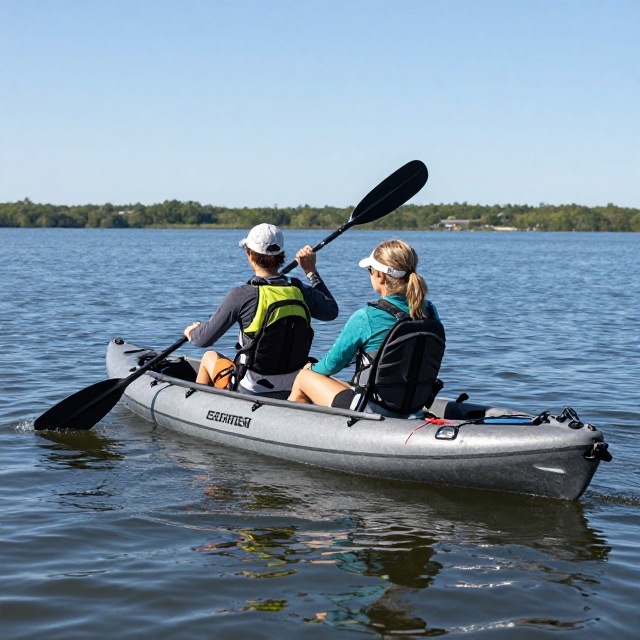
Best Tandem: Feelfree Lure II Tandem
Fishing with a partner—a spouse, a kid, a friend—adds a social dimension that solo boats can’t match, but tandems often compromise stability or fishing space. The Lure II Tandem is the rare two-person boat that doesn’t feel like a compromise. It’s stable, rigged for fishing, and can be soloed from the center seat when you go out alone.
Budget tandem option: The Brooklyn Kayak Company 13 Pro offers an 800-pound capacity and a trolling-motor-ready transom for families who want maximum versatility at a lower price.
How to Choose: The Four Factors That Actually Matter
Most buying guides drown you in specs. You don’t need every number. You need to understand the four trade-offs that shape every kayak decision.
1. Stability: Initial vs. Secondary
Kayak stability isn’t one thing. Initial stability is how rock-solid the boat feels when you first sit in it—wide, flat-bottomed hulls excel here. Secondary stability is how well the boat resists capsizing when it leans, and how predictably it recovers. A boat that feels “tippy” at rest can actually be more seaworthy than a barge-stable hull once conditions deteriorate.
Practical rule: If you want to stand and cast, prioritize width and a flat standing deck—35 inches or wider is a good starting point. If you’ll be paddling open water or dealing with chop, look for a hull with good secondary stability rather than maximum initial steadiness.
2. Weight Capacity: The Number Anglers Underestimate
Every kayak has a weight capacity—the total load of paddler, gear, and accessories it can carry while still performing safely. Exceeding it doesn’t just make the boat sluggish; it compromises stability and maneuverability.
A common mistake is buying a kayak whose capacity barely covers body weight and then adding a cooler, tackle crate, battery, motor, and anchor. A 325-pound capacity boat might be fine for a 180-pound angler with minimal gear, but it becomes limiting fast for a 250-pound angler who wants to stand and fish. Aim for at least 100 to 150 pounds of headroom above your body weight and typical gear load.
3. Propulsion: Paddle, Pedal, or Power
The propulsion decision drives everything else—cost, weight, maintenance, and the water you can fish.
-
Paddle is the lightest, cheapest, and simplest option. It’s ideal for small water, tight launches, and anglers who don’t mind using their arms to move between spots.
-
Pedal drive frees your hands and extends your range, but adds 10 to 30 pounds, a mechanical system to maintain, and a significant price premium. It’s worth it if you fish larger water, troll, or want to cast while moving.
-
Motorized and pedal-assist systems are the fastest-growing category. They let you cover water and hold position in wind, but they add cost, complexity, and weight—and in some jurisdictions, registration requirements may apply. Check your local regulations before buying.
4. Sit-On-Top vs. Sit-Inside
Most dedicated fishing kayaks are sit-on-top for good reason: they drain water through scupper holes, are easy to re-enter from the water, and provide a stable platform for standing and sight-fishing. Sit-inside kayaks offer better weather protection and a lower center of gravity, and models like the Native Ultimate FX12 blend sit-in comfort with sit-on-top openness. For most anglers, sit-on-top is the safer and more versatile default.
Practical Tips for Buying and Owning a Fishing Kayak
Demo before you buy. Every kayak feels different once you’re in it. A boat that reviews well can feel unstable or cramped for your body type. Join a local kayak fishing club, attend a demo day, or rent the model you’re considering for a half-day on real water.
Budget beyond the boat. The kayak is the down payment. A PFD, paddle (if not included), kayak cart, roof rack or trailer, anchor system, and basic safety gear can add hundreds of dollars. Factor these into your total cost before committing.
Think about storage and transport first. The best kayak is the one you can actually launch. A 130-pound pedal kayak that lives on a trailer is a different ownership experience than a 60-pound paddle kayak that fits in a garage corner and car-tops in five minutes. Be honest about your logistical reality.
Buy a PFD and wear it. Kayak Angler Magazine’s safety guidance is blunt: even strong swimmers need a life jacket on the water, because it’s nearly impossible to put one on after you fall in, and wind can blow a kayak away faster than you can swim. A USCG-approved Level 70 or Type III paddling PFD is non-negotiable.
Rinse your gear. Saltwater and sand destroy pedal drives and reels. A fresh-water rinse after every trip—especially for the drive unit—will add years to your investment.
Common Mistakes That Cost Anglers Money and Enjoyment
Mistake 1: Buying for the angler you want to be, not the one you are
It’s easy to imagine yourself standing and casting on a wide, stable platform every weekend. It’s harder to admit that you’ll mostly fish two-hour windows on a local lake and need a boat you can load alone. Buy for your actual fishing frequency, water type, and physical logistics—not your aspirational self.
Mistake 2: Underestimating weight
A 95-pound kayak doesn’t sound much heavier than a 65-pound one. But after a long day, in wind, on a slippery boat ramp, that 30-pound difference is the gap between “I’ll go out for an hour” and “I’ll skip it today.” If you’re solo and car-topping, prioritize hull weight over extra features.
Mistake 3: Ignoring secondary stability
New anglers often choose the widest, flattest boat they can find because it feels stable at the dock. But a flat, wide hull can be wet and sluggish in chop, and it may not lean predictably when a fish pulls or a wake hits. Demo the boat in the conditions you actually fish, not just on a calm pond.
Mistake 4: Over-rigging before learning the boat
It’s tempting to drill, mount, and wire every accessory on day one. But your first five trips will teach you where you actually need rod holders, where your paddle stroke interferes with gear, and how weight distribution affects trim. Fish the boat stock for a few outings before committing to permanent modifications.
Mistake 5: Skipping the motor registration check
Electric trolling motors and pedal-assist systems are blurring the line between kayak and boat. Some states and provinces require registration or permits for motorized kayaks, and the rules vary widely. A five-minute check with your local wildlife agency before buying a motorized setup can save you a citation later.
Pros, Cons, and the Balanced Truth About Fishing Kayaks
The pros are real: Fishing kayaks let you reach water that shore anglers can’t touch and big boats can’t enter—shallow flats, narrow creeks, weed-choked ponds, and rocky shorelines. They’re far cheaper than bass boats, need no gas, and launch almost anywhere. Modern hulls are stable enough to stand in, pedal drives free your hands, and the rigging potential is enormous.
The cons are equally real: Kayaks are exposed to weather and wake. They demand physical effort to launch, load, and paddle. Pedal and motor systems add weight, cost, and maintenance. Storage can be a genuine constraint for apartment dwellers. And on big, open water with wind and current, a kayak is a small, slow vessel that requires careful judgment and safety discipline.
The balanced take: A fishing kayak is not a smaller, cheaper bass boat. It’s a different kind of fishing—more intimate, more physical, and more dependent on your own skill and preparation. Anglers who embrace that trade-off tend to love kayak fishing more than any other form of angling. Anglers who buy a kayak expecting boat-like comfort and range often end up disappointed.
The Future of Fishing Kayaks: What to Watch Through 2026 and Beyond
Three developments are worth watching.
Electric propulsion will keep expanding. Pedal-assist systems like Old Town’s ePDL and standalone trolling motors are making kayak fishing accessible to anglers who lack the stamina for long paddles or pedals. As battery technology improves and prices fall, “e-kayaks” will likely become a mainstream category rather than a premium niche.
Jet drives and alternative propulsion could reshape shallow-water fishing. The FluxJet’s Best of Show win at ICAST signals industry appetite for propulsion systems that don’t hang below the hull. If jet drives prove reliable and affordable, they could solve the shallow-water limitation that plagues prop drives.
Smart integration will make rigging simpler. Touchscreen fish finders, GPS-guided trolling motors, and plug-and-play electronics are lowering the learning curve for kayak anglers who want advanced capability without a wiring project. The kayak of 2030 may be as much a connected device as a hull.
The through-line is clear: kayaks are becoming more capable, more specialized, and more expensive. The angler who benefits most will be the one who defines their needs clearly before shopping, rather than chasing every new feature.
Conclusion: Key Takeaways for Buying Your Next Fishing Kayak
-
There is no single best fishing kayak. The right boat depends on your water, your fishing style, your storage, and your budget—not on a spec-sheet winner.
-
Match propulsion to your reality. Paddle for simplicity and light weight; pedal for hands-free range and larger water; motorized for maximum capability at the cost of weight, price, and potential registration.
-
Prioritize weight and transport logistics. The kayak you can launch alone is the kayak you’ll actually use. Demo before you buy and be honest about your car-topping limits.
-
Respect weight capacity and stability. Aim for 100–150 pounds of capacity headroom, and understand the difference between initial and secondary stability.
-
Top picks by category: NuCanoe Unlimited Max (overall versatility), Wilderness Systems A.T.A.K. 120 (sit-on-top paddling), Old Town Sportsman 120 PDL Pro (pedal value and rigging), Hobie Mirage Pro Angler 12 (premium fin drive and offshore capability), Pelican Catch Classic (budget entry), Hobie iTrek Angler (inflatable convenience), and Feelfree Lure II Tandem (two-person fishing).
-
Safety is not optional. Wear a USCG-approved PFD every time, know the navigation rules, and check local regulations if you add a motor.
-
Buy for the angler you are today, not the one you hope to become—and leave room to upgrade once you’ve learned what you actually need.
Frequently Asked Questions
What is the best fishing kayak for a beginner?
A stable, paddle-powered sit-on-top in the 10–12 foot range with a comfortable raised seat and a few accessory tracks is the ideal starting point. The Pelican Catch Classic and Vibe Sea Ghost 110 are strong value picks, while the Native Falcon 11 offers a lightweight, easy-to-handle option for solo anglers.
Is a pedal kayak worth the extra money?
If you fish larger water, troll, or want to cast while moving, yes. Pedal drives free your hands and extend your range, but they add 10–30 pounds, a mechanical system to maintain, and a significant price premium. For small ponds and occasional use, a paddle kayak is usually the better value.
How much weight capacity do I need?
Aim for at least 100–150 pounds above your body weight plus your typical gear load. A 325-pound capacity kayak can work for a lighter angler with minimal gear, but it becomes limiting quickly if you add a cooler, battery, motor, or tackle crate—especially if you want to stand and fish.
Can I stand up and fish from a kayak?
Yes—if the hull is wide enough and stable enough. Look for a beam of at least 34–36 inches and a dedicated standing deck. Models like the Bonafide PWR129, Jackson Big Rig FD, and Blue Sky Boatworks 360 Angler are explicitly designed for standing and casting.
What’s the difference between a sit-on-top and a sit-inside fishing kayak?
Sit-on-top kayaks drain water through scupper holes, are easier to re-enter from the water, and provide a more stable platform for standing. Sit-inside kayaks offer better weather protection and a lower center of gravity, but they can swamp if filled with water. Most dedicated fishing kayaks are sit-on-top for safety and versatility.
Do I need to register a motorized fishing kayak?
It depends on your jurisdiction. Electric trolling motors and pedal-assist systems can trigger registration or permitting requirements in some states and provinces, and the rules vary widely. Check with your local wildlife or boating agency before buying a motorized setup.
Are inflatable fishing kayaks as good as hard-shell ones?
Premium inflatables like the Hobie iTrek Angler now deliver a fishing experience comparable to many rotomolded kayaks, and they solve storage and transport problems that hard-shells can’t. They still sacrifice some hull efficiency and require more setup time, but for apartment dwellers and travelers, they’re a legitimate choice rather than a compromise.
Sources
-
Field & Stream, “The Best Fishing Kayaks, Reviewed” (Feb 2026)
-
Kayak Angler Magazine, “Best Fishing Kayaks For 2026 Buyer’s Guide”
-
Kayak Angler Magazine, “Best Pedal Fishing Kayaks For 2026 Buyer’s Guide”
-
Kayak Angler Magazine, “ICAST Day Two And Our New Favorite Fishing Gear For 2026”
-
CF Outdoors, “Best Fishing Kayaks: 2026 Buying Guide”
-
Eco Fishing Shop, “Old Town vs. Hobie vs. Jackson vs. Native: Which Pedal Drive Kayak Is Right for You?” (2026)
-
The Paddle Sport Show, “HOBIE: ITrek Angler – 2026 Product of the Year (Kayak Fishing)”
-
HTF Market Intelligence, “Fishing Kayak Market Global & Geographic Analysis with Growth Forecast to 2034” (2026)
-
PaddleVA, “How to Choose a Fishing Kayak + Best for Beginners” (2026)
-
Coastal Angler Magazine, “So You Want to Fish From a Kayak?” (stability and capacity background)

Novara Lin
Senior Editor & Clean Beauty Analyst
Novara Lin is a clean beauty researcher and wellness editor dedicated to demystifying modern skincare and evidence-based living. With a background in formulation science and consumer health reporting, she specializes in analyzing complex ingredient profiles, evaluating product safety, and bridging the gap between clinical research and daily self-care routines. Her work focuses on helping readers cut through industry noise to build minimal, highly effective routines rooted in transparency and skin health. When she isn’t testing active formulations or auditing non-toxic household choices, Novara leads editorial strategy for NovaRa Pure.