
We Tested:
Imagine receiving a summons in the mail. You aren’t being called for trial duty—no judge will preside, and there is no defendant sitting across the room. Instead, you are ushered into a closed chamber with 22 strangers. A prosecutor hands you evidence. You are told you have the power to formally accuse someone of a federal felony, potentially setting in motion a legal battle that could cost them their liberty.
You are now a grand juror.
For most Americans, the grand jury is a black box. It operates in near-total secrecy, lacks a judge, and usually produces exactly one outcome: an indictment. In 2016, federal prosecutors investigated over 150,000 suspects; grand juries declined to indict in just six cases . That is a rejection rate so vanishingly small it barely registers as a statistic.
But in 2025 and 2026, that black box has been rattled. High-profile cases involving political figures have thrust the grand jury into headlines, revealing a institution that is simultaneously a shield for the accused, a tool for the prosecutor, and a constitutional mystery. Whether you are a civic enthusiast, a legal professional, or someone who simply wants to understand the news, grasping how the grand jury works—and how it fails—is essential.
Let’s pull back the curtain on the grand jury: what it is, how it actually functions, where it goes wrong, and what the future holds for this ancient gatekeeper of American justice.
Background: A Relic of the Magna Carta That Still Runs the Show
The grand jury is not an American invention. Its roots trace back to 12th-century England and the Magna Carta, where local citizens were assembled to accuse wrongdoers. The Founding Fathers, deeply suspicious of centralized prosecutorial power, embedded this institution into the Fifth Amendment of the U.S. Constitution: “No person shall be held to answer for a capital, or otherwise infamous crime, unless on a presentment or indictment of a Grand Jury”.
The logic was elegant. A petty (trial) jury decides guilt. A grand jury—the word simply means “large,” referring to its size compared to a trial jury—decides whether the government has enough evidence to even try you. It was designed as a “panel of the people,” a buffer between an overzealous crown (or, later, an overzealous federal prosecutor) and the individual.
But here is the first thing most people get wrong: The grand jury is not a trial. It does not determine innocence or guilt. It determines probable cause—a standard so low it has been famously described as the prosecutor’s best friend.
Main In-Depth Sections
The Mechanics: 23 Strangers, One Prosecutor, and Zero Defense Attorneys
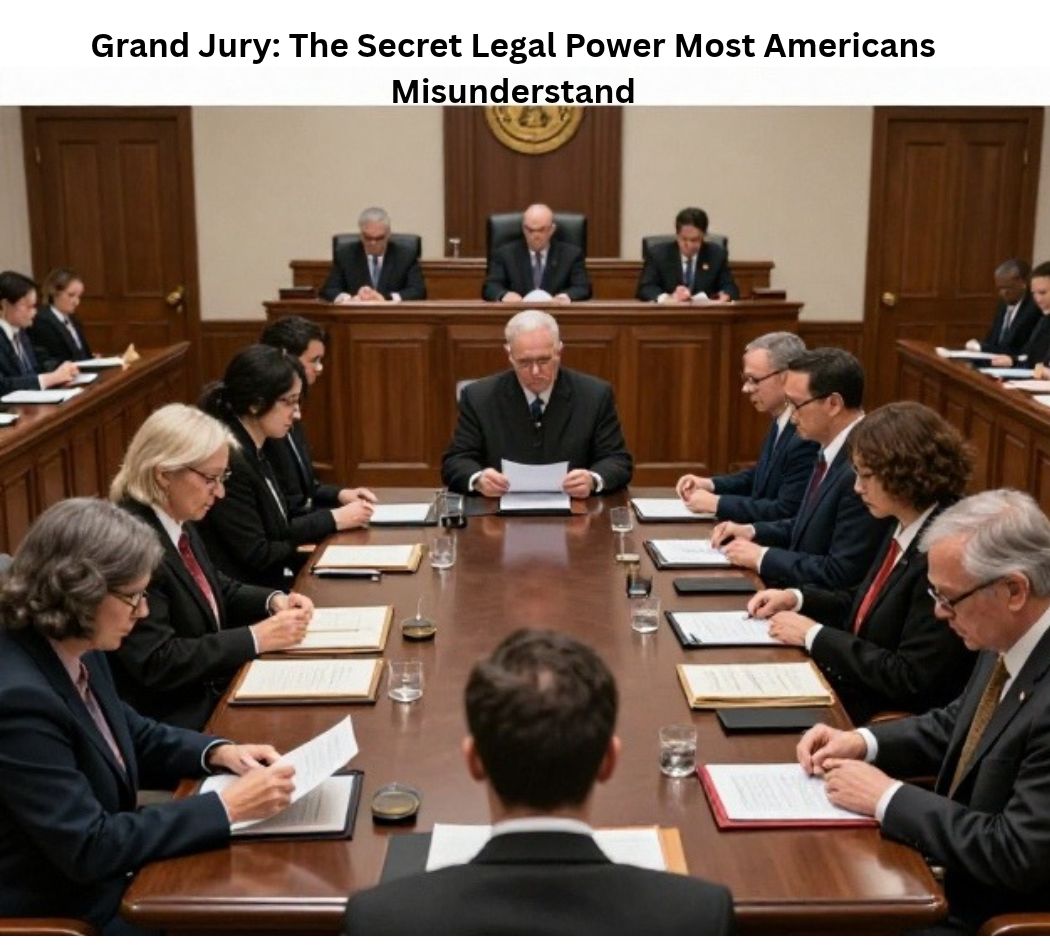
Understanding the grand jury requires accepting a fundamentally asymmetrical reality. In a federal felony case, the grand jury consists of 16 to 23 members, randomly selected from the community. They serve for up to 18 months (sometimes 24), hearing dozens of cases during their term.
The procedure is unlike anything you see on television.
Inside the room, the prosecutor is the sole legal authority. The suspect—known as the “target”—has no right to be present, no right to call witnesses, and no right to cross-examine anyone. The defense attorney is not allowed inside. Only the jurors, the prosecutor, a court reporter, and the witnesses are present.
To secure an indictment, the prosecutor needs only to convince 12 of the 23 jurors that probable cause exists. The prosecutor is not even legally obligated to present exculpatory evidence that might prove the target’s innocence. As legal scholars often put it: a competent prosecutor could indict a ham sandwich. The adage endures because, statistically, it is practically true.
The “No Bill”: When the Ham Sandwich Fights Back
If the system is so stacked, how did a federal grand jury in Virginia refuse to indict New York Attorney General Letitia James in December 2025?
This is where the grand jury becomes genuinely fascinating. In the James case, the Justice Department sought a re-indictment after a judge had dismissed an earlier case due to an improperly appointed prosecutor. The grand jury, after hearing the evidence presented by a new prosecutor, declined to sign off. It returned a “no bill”.
This almost never happens. The reasons are structural: prosecutors control the flow of information, and grand jurors are dependent on them for legal guidance. When a grand jury does refuse, it is a signal that the prosecutor’s case was either unusually weak, procedurally flawed, or that the jurors exercised an independence that the system rarely demands of them.
According to data compiled by Professor Niki Kuckes, in 2016—a representative year—federal grand juries rejected indictments only six times out of roughly 130,000 cases. The James refusal was not just unusual; it was a statistical anomaly that exposed the human element inside a bureaucratic machine.
The Investigative Muscle: Subpoenas, Secrets, and the “Runaway” Jury
The grand jury is not merely a rubber stamp for indictments. It possesses enormous investigative power. It can issue subpoenas for documents and testimony, compel witnesses to appear, and hold those who refuse in contempt.
Historically, this power allowed grand juries to act as independent investigators—sometimes investigating government corruption without a prosecutor’s blessing. These were called “runaway” grand juries. Today, that independence has largely vanished. The prosecutor “fills in the blanks” on subpoenas and decides which witnesses to call. The grand jury’s investigative muscle is almost always flexed at the direction of the state.
Secrecy is the glue that holds this system together. Grand jurors are forbidden from discussing proceedings, even after their term ends. The rationale is protective: it shields innocent suspects from public suspicion, prevents witness tampering, and encourages reluctant witnesses to speak freely. But secrecy also shields the process from scrutiny. If a prosecutor abuses the grand jury—presenting fabricated evidence or hiding exculpatory material—the public may never know.
The 2025–2026 Reckoning: When Politics Enters the Room
The grand jury’s invisibility makes it a tempting tool for political weaponization. In 2025, the Justice Department under President Trump sought indictments against prominent adversaries, including Letitia James and former FBI Director James Comey. When career prosecutors resisted, they were replaced. When a judge found the replacement prosecutor’s appointment unlawful, the cases collapsed.
The grand jury’s role in these episodes was paradoxical. On one hand, it was the mechanism through which the executive branch attempted to exercise power. On the other, it was a grand jury’s refusal to indict James that delivered a stinging rebuke to the administration.
This tension has not gone unnoticed. In September 2026, the watchdog group CREW submitted a formal recommendation to the Advisory Committee on Criminal Rules, urging a rule change that would require notice when a grand jury declines to indict. Their argument is simple: if the grand jury is a check on prosecutorial power, the public should know when that check is exercised. Currently, a “no bill” can disappear into the secrecy of the grand jury room, leaving the target unaware that they were even investigated.
CREW also noted a troubling trend: over the past year and a half, federal grand juries have declined to indict in at least 18 cases, a figure that federal judges have described as reflecting “unprecedented prosecutorial action” and concerns that “once-forbidden political considerations are infecting prosecutorial decisions”.
Practical Tips: What to Do If You Are Summoned
If you receive a grand jury summons as a juror, congratulations—you are about to see the criminal justice system from a vantage point few civilians ever access. Here is how to approach it:
-
Leave your preconceptions at the door. You are not deciding guilt. You are deciding whether there is enough evidence to warrant a trial. The standard is “probable cause,” not “beyond a reasonable doubt.”
-
Ask questions. You have the right to ask the prosecutor for clarification. If the legal instructions are confusing, speak up. You are not a potted plant.
-
Pay attention to what is not presented. If the prosecutor’s case feels one-sided (and it will), remember that the defense has no voice here. Your job is to assess the government’s evidence, not to conduct your own investigation.
If you receive a subpoena as a witness:
-
Take it seriously. Failure to comply can result in civil or criminal contempt.
-
You can invoke the Fifth Amendment. If your testimony could incriminate you, you must appear but can refuse to answer specific questions by invoking your privilege against self-incrimination.
-
You cannot bring your lawyer into the room. Counsel can wait outside, but they cannot accompany you before the grand jury.
Common Mistakes and Challenges
Mistake #1: Assuming the grand jury is a fair fight.
It is not designed to be. The grand jury is an accusatory body, not an adjudicative one. Expecting it to function like a trial will lead to confusion and frustration.
Mistake #2: Believing secrecy means fairness.
Secrecy protects the investigation, but it also prevents oversight. When prosecutors abuse the process, the secrecy rules make it difficult for the public—or even the targets—to detect the abuse until it is too late.
Challenge: The “Rubber Stamp” Problem.
Because the prosecutor controls the evidence, the witnesses, and the legal instructions, the grand jury’s independence is largely theoretical. A 2010 study by the National Association of Criminal Defense Lawyers found that federal grand juries are “dominated by prosecutors” and rarely exercise independent judgment. The system relies on prosecutorial ethics rather than structural checks.
Solution: Transparency Reforms.
The CREW proposal to require notice of “no bills” is one modest step. Broader reforms—such as allowing defense counsel to present evidence (as some states do) or requiring prosecutors to present exculpatory evidence—would make the grand jury a more genuine check. But these reforms face steep opposition from prosecutors’ associations, who argue they would turn the grand jury into a mini-trial and defeat its investigative purpose.
Pros, Cons, and Balanced Analysis
The Case for the Grand Jury:
-
It prevents frivolous prosecutions. Requiring a panel of citizens to approve felony charges filters out weak cases before they reach a trial jury.
-
It protects the innocent from public accusation. Secrecy means that if a grand jury declines to indict, the target’s reputation is not publicly damaged.
-
It brings community values into the system. Grand jurors are ordinary citizens, not legal professionals. Their presence ensures that prosecutorial decisions are reviewed by a lay cross-section.
The Case Against:
-
It is structurally biased toward the prosecution. The target has no voice, no counsel, and no right to present evidence.
-
It is a tool for political weaponization. As the 2025 cases demonstrated, a determined executive branch can use the grand jury to harass political opponents, even if the indictments are later dismissed.
-
Its secrecy prevents accountability. If a prosecutor misleads the grand jury, the public may never find out. The absence of a judge or a defense attorney means there is no contemporaneous check on prosecutorial misconduct.
The Balanced View:
The grand jury is neither a sacred bulwark of liberty nor a mere rubber stamp. It is a contingent institution. When prosecutors behave ethically and present cases honestly, the grand jury is a reasonable filter. When prosecutors behave politically, the grand jury becomes a weapon. The difference lies not in the institution itself, but in the norms and accountability mechanisms surrounding it.
Future Trends and Predictions
1. The Push for Data Transparency
Expect to see growing pressure for courts to publish anonymized data on grand jury outcomes, including “no bill” rates by district and by prosecutor. The CREW petition is a harbinger of a broader movement toward metrics-based oversight of prosecutorial discretion.
2. State-Level Experimentation
While federal grand jury reform is slow, states are laboratories. Kansas, for example, has considered legislation to modify “citizen petition” processes for impaneling grand juries, reflecting a populist desire for more direct citizen control over accusations. Watch for more state-level debates about whether grand juries should be abolished entirely (as some progressive reformers argue) or expanded.
3. The “Weaponization” Debate Will Intensify
The 2025 cases have permanently politicized the grand jury in the public imagination. Whether the next administration is Democratic or Republican, the temptation to use the grand jury against opponents will remain. The only real antidote is a professionalized civil service within the Justice Department that resists political pressure—a norm that appears increasingly fragile.
4. Technology and Secrecy
As digital evidence becomes central to criminal investigations, the grand jury’s secrecy rules will face new challenges. Can a grand jury review encrypted communications? How do you subpoena a cloud server? The legal framework for grand jury investigations was built for a paper world. It will need to adapt.
Conclusion: Key Takeaways
-
The grand jury is a charging body, not a trial body. It decides probable cause, not guilt, and it operates with a structural bias toward the prosecution.
-
It is designed to be secret. That secrecy protects the innocent but also shields prosecutorial misconduct from scrutiny.
-
“No bills” are extraordinarily rare. In 2016, grand juries rejected only 6 indictments out of roughly 130,000 cases. The 2025 refusal to indict Letitia James was a statistical outlier that highlighted the system’s dependence on prosecutorial restraint.
-
The institution is under strain. Political weaponization, calls for transparency, and the inherent asymmetry of the process are forcing a reckoning with how the grand jury actually functions in modern America.
-
Reform is possible but difficult. Modest transparency measures, like requiring notice of “no bills,” are gaining traction. Structural reforms, like allowing defense counsel into the room, face stiff opposition.
Quick Summary Box:
The grand jury is a 23-person panel that decides whether there is probable cause to charge someone with a federal felony. It meets in secret, hears only the prosecutor’s evidence, and almost always indicts. Its power is enormous, its transparency is minimal, and its future depends on whether the legal system can rebuild norms that prevent it from becoming a political tool.
Detailed FAQs
Q: Can I refuse to serve on a grand jury?
A: Generally, no. Jury service is a civic obligation. You can request a deferral or excusal for hardship (medical issues, caregiving responsibilities, etc.), but a summons is a legal order. Failure to appear can result in contempt of court.
Q: Does the target of a grand jury investigation have any rights?
A: Yes, but they are limited. The target has the right to remain silent (if subpoenaed to testify), the right to counsel (outside the room), and the right to challenge the indictment after it is returned (e.g., on grounds of prosecutorial misconduct). They do not have the right to be present, to call witnesses, or to cross-examine the government’s witnesses.
Q: What is the difference between a grand jury and a trial jury?
A: A trial (petit) jury has 6–12 members, sits for one trial, and decides guilt beyond a reasonable doubt. A grand jury has 16–23 members, sits for months, and decides probable cause. The trial jury is public and adversarial; the grand jury is secret and inquisitorial.
Q: Can a grand jury investigate someone without a prosecutor?
A: In theory, yes—this is called a “runaway” grand jury. In practice, it almost never happens. Grand jurors lack the investigative resources and legal expertise to conduct an investigation independently, and courts generally defer to the prosecutor’s direction.
Q: What happens if a grand jury refuses to indict?
A: The prosecutor can (1) present the case again to the same or a different grand jury, (2) appeal the refusal if there is a legal basis, or (3) drop the case. The target is not formally cleared, but the practical effect is usually the end of the investigation.
Q: Is the grand jury system used in other countries?
A: The grand jury is a distinctly Anglo-American institution. The United Kingdom abolished grand juries in 1933 (except in a limited form in Liberia). Most civil-law countries use an investigating magistrate or a prosecutor-led model instead. The U.S. federal system and a handful of states are the primary remaining users of the grand jury.
Sources
-
United States Courts, “Types of Juries”
-
ABA Journal, “Grand jury refuses to reindict Letitia James in mortgage fraud case” (Dec. 2025)
-
CREW, “CREW recommends transparency reform for when grand juries refuse to indict” (Sept. 2026)
-
U.S. Courts, District of Idaho, “What is Grand Jury?”
-
Congressional Research Service, “The Federal Grand Jury”
-
BBC News, “Grand jury declines to charge Letitia James after first case dismissed” (Dec. 2025)
-
U.S. Courts, Eastern District of Tennessee, “The Grand Jury – The People’s Gatekeeper”
-
Federal Judicial Center, “Juries in the Federal Judicial System”
-
Kansas State Legislature, Hearing on HB 2529 (Jan. 2026)

Novara Lin
Senior Editor & Clean Beauty Analyst
Novara Lin is a clean beauty researcher and wellness editor dedicated to demystifying modern skincare and evidence-based living. With a background in formulation science and consumer health reporting, she specializes in analyzing complex ingredient profiles, evaluating product safety, and bridging the gap between clinical research and daily self-care routines. Her work focuses on helping readers cut through industry noise to build minimal, highly effective routines rooted in transparency and skin health. When she isn’t testing active formulations or auditing non-toxic household choices, Novara leads editorial strategy for NovaRa Pure.